Space from a Hypergraph
Space isn't a stage the universe sits on — it's the large-scale shape of the hypergraph itself, the same web that everything else is made of.
In The Principle of Computational Equivalence we saw why almost any simple rule can produce behaviour as rich as anything in nature. Now we cash that in for something concrete: space.
Here’s the move that makes the whole project tick. We do not start with space and then put a hypergraph inside it. There is no grid, no coordinates, no “where” for anything to be. There is only the hypergraph — a tangle of relations between featureless nodes. [setup] What we call space is nothing more than the large-scale shape of that tangle, the pattern you see when you zoom out far enough that individual nodes blur together.
And there’s a lovely consequence: since the hypergraph is all there is, space and the things in space are the same structure. A particle isn’t an object sitting in space — it’s a persistent little knot of space. “Everything is made of space” is meant quite literally. Wolfram puts it exactly this way. [setup]
Watch space grow
Below is the grow rule again — every edge keeps itself and sprouts a fresh node.
Try not to think of the picture as a diagram drawn on a page. The layout is just
for our eyes; the only thing that’s real is which node connects to which. This
growing web doesn’t sit in space — it is space, knitting itself into existence
one update at a time:
{x, y} → {x, y}, {y, z} — each edge keeps itself and sprouts a new nodeTry this: play it to the end, then pick any node and ask “how much of the universe is near me?” Count its neighbours, then the neighbours-of-neighbours, and so on. The rate at which that count piles up as you reach farther out is the seed of the idea on this whole page.
How a tangle gets a dimension
Ordinary space has a dimension — three of them, in fact — and we usually take that number as given. In the Wolfram model nobody hands it to you. So how could a bare network ever “have” a dimension at all?
The trick is to measure it the way you could measure ours without ever leaving home. Stand on a node. Count how many nodes lie within distance — meaning at most hops away through the edges. Now grow and watch the count climb. In flat 2D space a disc of radius holds an amount of stuff that grows like ; in 3D a ball grows like . So if a region of the hypergraph has the count growing like , we simply call its effective dimension. [derived-in-model]
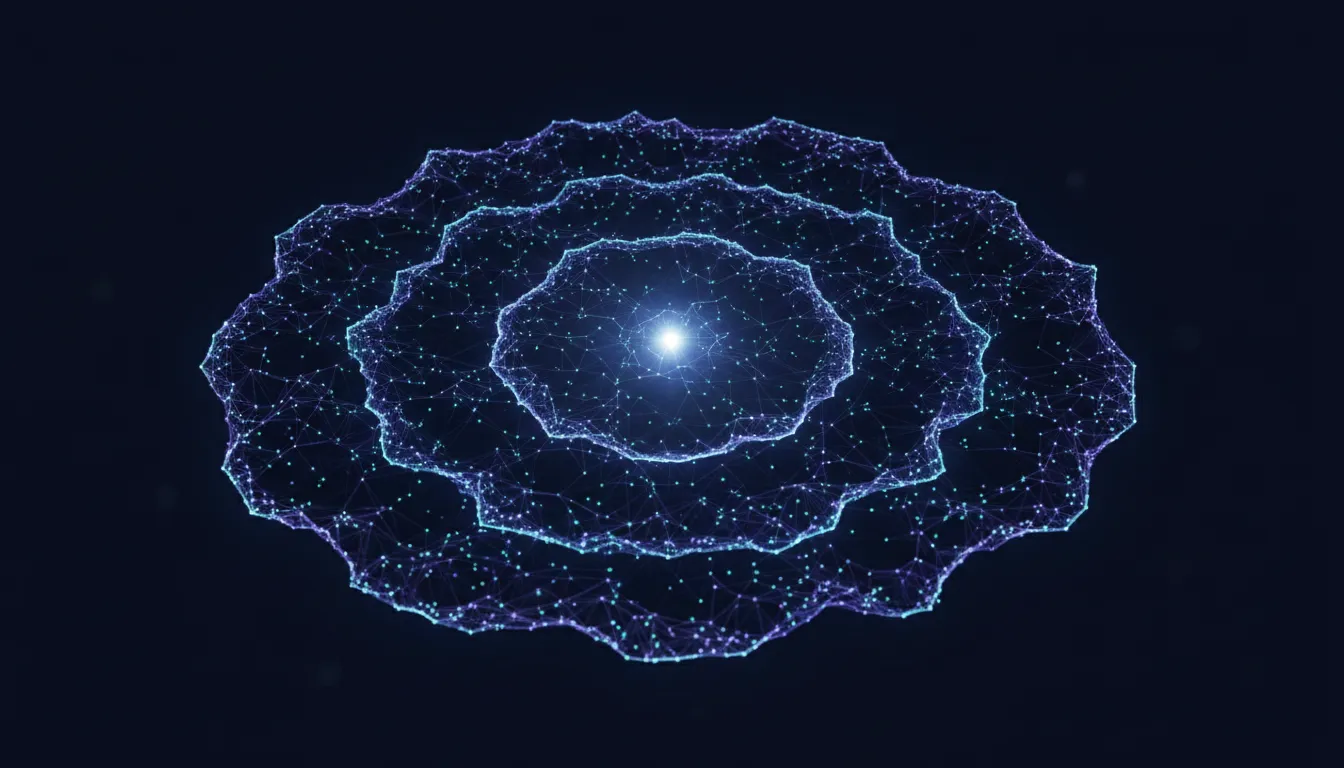
The striking part is that this number comes out non-trivial, and rule-dependent. Run the measurement on the example rules Wolfram studies and you don’t just get junk: some settle near a dimension of about , others around , and some land on honestly fractional values — a kind of network that isn’t 2-dimensional or 3-dimensional but somewhere in between. These specific numbers come from the announcement. [derived-in-model]
That a featureless web can pin down a number like — with nothing in the rule that mentions “dimension” anywhere — is the first real sign that recognisable geometry can grow out of pure rewriting.
The precise version (and why you need 'medium' distances)
Operationally: pick a node, let be the number of nodes within graph distance , and read off the exponent for which . That is the effective (Hausdorff-like) dimension of the hypergraph around that point. [derived-in-model]
Why “effective”? Because the clean power law only lives in the middle:
- At small you’re looking at a handful of nodes — the discreteness shows through and the count is too lumpy to fit a smooth power.
- At large you run into the edge of the structure (or its global curvature), and the simple stops holding.
So a trustworthy estimate needs intermediate — large enough to average over the graininess, small enough not to hit the boundary. Get a stable exponent there and you can sensibly say the space “has” that dimension. This is also why fractional answers (for instance the of some tree-like rules) are perfectly legitimate: nothing forces to be a whole number. Grounded in the announcement and the technical paper.
Where this leaves us
So dimension isn’t assumed — it’s grown, and measured, and for the right rule it could in principle come out as the we live in. [conjecture] Importantly, nobody has found a specific rule whose large-scale limit is our universe; the model shows that emergent dimension is possible, not which rule delivers it. The essay is explicit that the rule for our universe is not known. [setup]
Once a network behaves like smooth space with a dimension, the obvious next question is whether it can also bend. Counting nodes within distance gave us dimension; looking at the small correction to that same count is exactly what reveals curvature — and curvature, in this story, is gravity. That’s Curvature & Gravity.
Sources for this page: 2020 announcement · Technical paper