Special Relativity
A moving observer slices the causal graph at a tilt — and that single geometric tweak is enough to make clocks run slow and pin a universal speed limit.
In Time, Foliations & Reference Frames we found that a “moment of now” is just a slice through the causal graph, and that a whole stack of such slices — a foliation — is a reference frame. We also saw the hinge: because causal invariance guarantees everyone agrees on the underlying web of cause and effect, different observers are free to slice that web differently and none of them is wrong.
Now we cash that in. The remarkable claim of this page is that once you let observers slice the same causal graph at different tilts, two of the strangest facts about our universe — that moving clocks run slow, and that nothing outruns light — fall out almost for free. No clocks or light were put in by hand. They’re shadows of how a tilted slice cuts through a fixed pattern of events. [derived-in-model]
One graph, two observers
Here’s the same causal graph again. Think of an observer as a stack of horizontal slices sweeping down it — each slice a tick of their clock, the events caught between two consecutive slices being “what happened this tick.”
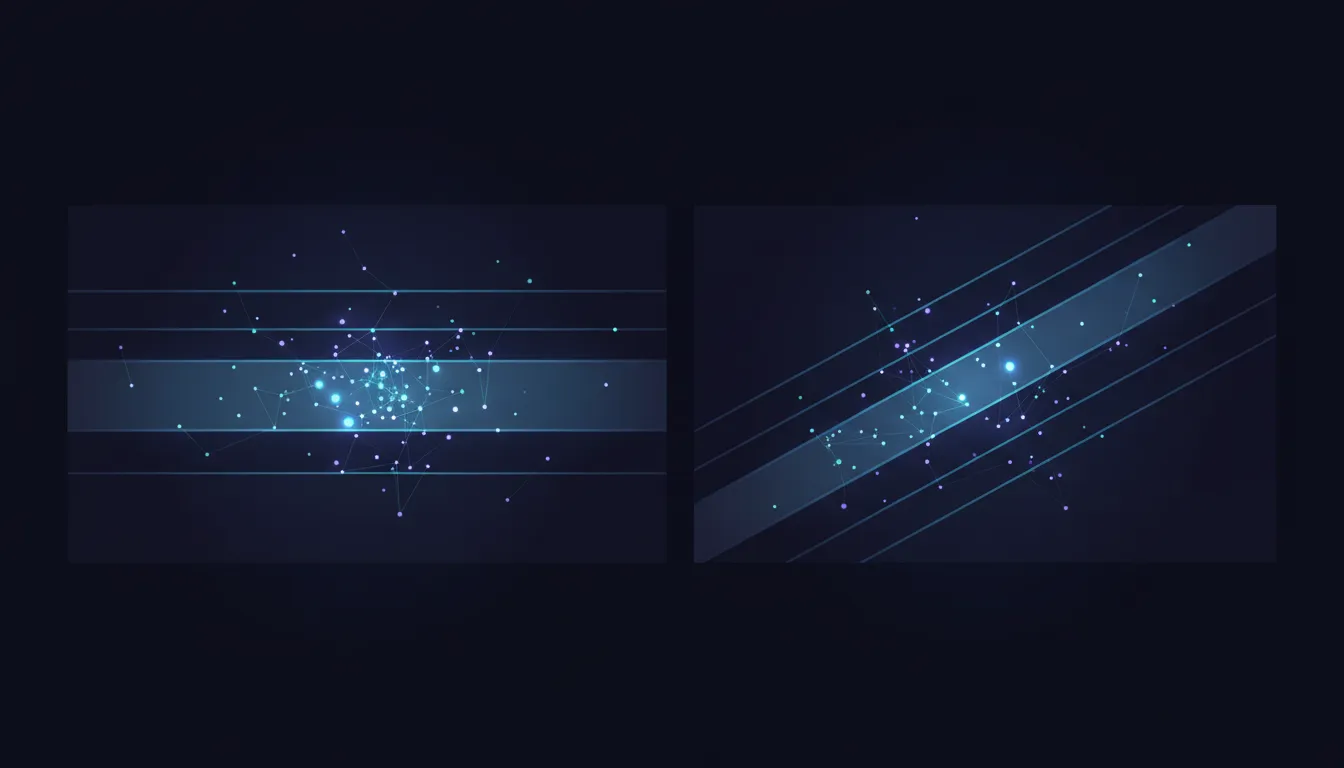
Try this: step to the end, then picture two different sweeps. A stationary observer slices straight across, catching a full row of events per tick. A moving observer slices at a tilt — and a tilted line crossing the same graph catches fewer events between consecutive slices. Fewer events per tick is the whole story: that observer’s clock has “done less” in the same stretch of the graph.
That picture — a tilted slicing sampling events more sparsely — is the model’s version of time dilation. The moving observer isn’t lazy or broken; they’re reading the very same causal graph, just along a slanted foliation, and a slant simply meets fewer events per step. [derived-in-model]
Where the Lorentz factor comes from
Quantify “how much sparser,” and the familiar number drops out. The slowdown of the moving clock is set by the Lorentz factor
— the same from textbook special relativity, where is the relative speed and the maximum signal speed. The point worth holding onto isn’t the algebra; it’s that the tilt of a foliation plays the role of velocity, and the geometry of cutting a fixed causal graph at that tilt reproduces . Wolfram stresses this isn’t a quirk of one hand-picked toy rule: the derivation is argued to go through for any rule that has causal invariance. [derived-in-model] (2020 announcement)
Why there’s a speed limit at all
The same slicing picture also explains the cosmic speed limit — and here the argument is pleasingly blunt. A foliation is only legal if it respects causality: no slice may put an effect into an earlier moment than its cause. Tilt your slices too far and you’d start ordering effects before their causes, which the causal graph forbids outright. There’s a hard limit on how far you can tilt — picture it as 45 degrees in a spacetime diagram — and that maximum tilt is exactly a maximum signal speed. Reach it and you’re moving as fast as cause-and-effect itself can propagate. We call that speed , the speed of light. [derived-in-model]
In the simplest string toy model that maximum rate is concrete: information can spread at most one character per step of the rewriting, and nothing in the system can outrun that. [setup] It’s the rule’s own clock rate for “how fast news travels,” not a constant bolted on afterward.
Slice it yourself
The lattice below is an idealised patch of spacetime — the dots are events and the faint diagonals are light cones (one space-step per time-step). The coloured lines are one observer’s foliation: their successive slices of “now”. Change the observer’s velocity to tilt the slicing.
Try this: the two ringed events lie on the same coloured slice at v = 0 — they happen “at the same time”. Nudge the velocity and they jump onto different slices (simultaneity is relative), while the time-dilation factor γ climbs above 1. Notice the slices always stay shallower than the diagonal light cones — you simply can’t tilt past the speed of light.
The precise version (and exactly what is and isn't claimed)
The honest framing: this is a model-internal derivation that reproduces special relativity, not an independent experimental confirmation of it. Special relativity has been tested to exhaustion for over a century; what’s new here is the claim that it emerges from causal-graph foliations, given causal invariance — for any causally invariant rule, not just the examples shown. [derived-in-model]
The chain of reasoning is:
- Causal invariance ensures the causal graph is the same no matter how the rule is applied, so it can be sliced by many different observers consistently (see Causal Invariance). [setup]
- A foliation of that graph is identified with an inertial frame; tilting the slicing corresponds to relative motion (see Time, Foliations & Reference Frames). [setup]
- A tilted slicing samples events more sparsely per tick, reproducing time dilation and the Lorentz factor ; the causality constraint caps the tilt, fixing a maximum signal speed . [derived-in-model]
The formal, peer-reviewed version — including the continuum limit in which the discrete causal structure is argued to approach Lorentzian spacetime — is in Gorard’s relativity paper, which identifies causal invariance as the central condition for relativistic invariance and is the source to trust over the popular essays.
A note of caution
Keep the same balance as the rest of these notes. That special relativity should fall out of nothing but “slice a causal graph consistently” is genuinely elegant, and the causality-bounds-the-tilt argument for a speed limit is intuitive. But “reproduces” is not “independently confirms,” and a model flexible enough to recover known physics is also flexible enough to worry skeptics. Reviewing the project in Scientific American, Scott Aaronson argued the framework can be tuned to fit results after the fact, and the relativity claims are presented in Wolfram’s own essays as model-internal arguments rather than finished theorems. [setup] (Scientific American critique) That’s why the page above says reproduced within the model and sends you to Gorard’s formal paper for the careful treatment.
With moving clocks and a speed limit in hand, the natural next step is to let that same causal structure bend — and ask whether the model can recover gravity too, in General Relativity & Gravity.
Sources for this page: Gorard — relativity & gravity · 2020 announcement · Technical paper · Scientific American critique