Hypergraphs & Rewriting
The starting point of the Wolfram model — structureless collections of relations, updated by a single rewriting rule.
In the Wolfram model, the lowest level of reality isn’t particles or fields — it’s just a big collection of relations between abstract elements. There’s no built-in space, no coordinates, no geometry. Only a set of connections.
The hypergraph
We record the relations as a hypergraph: a set of hyperedges, where each hyperedge is an ordered list of elements (nodes). Where an ordinary graph edge joins exactly two nodes, a hyperedge can join any number. A state of the universe is written as a set like
The node labels (1, 2, 3) carry no meaning of their own — only the pattern of connections matters. Relabel every node and you have literally the same universe.
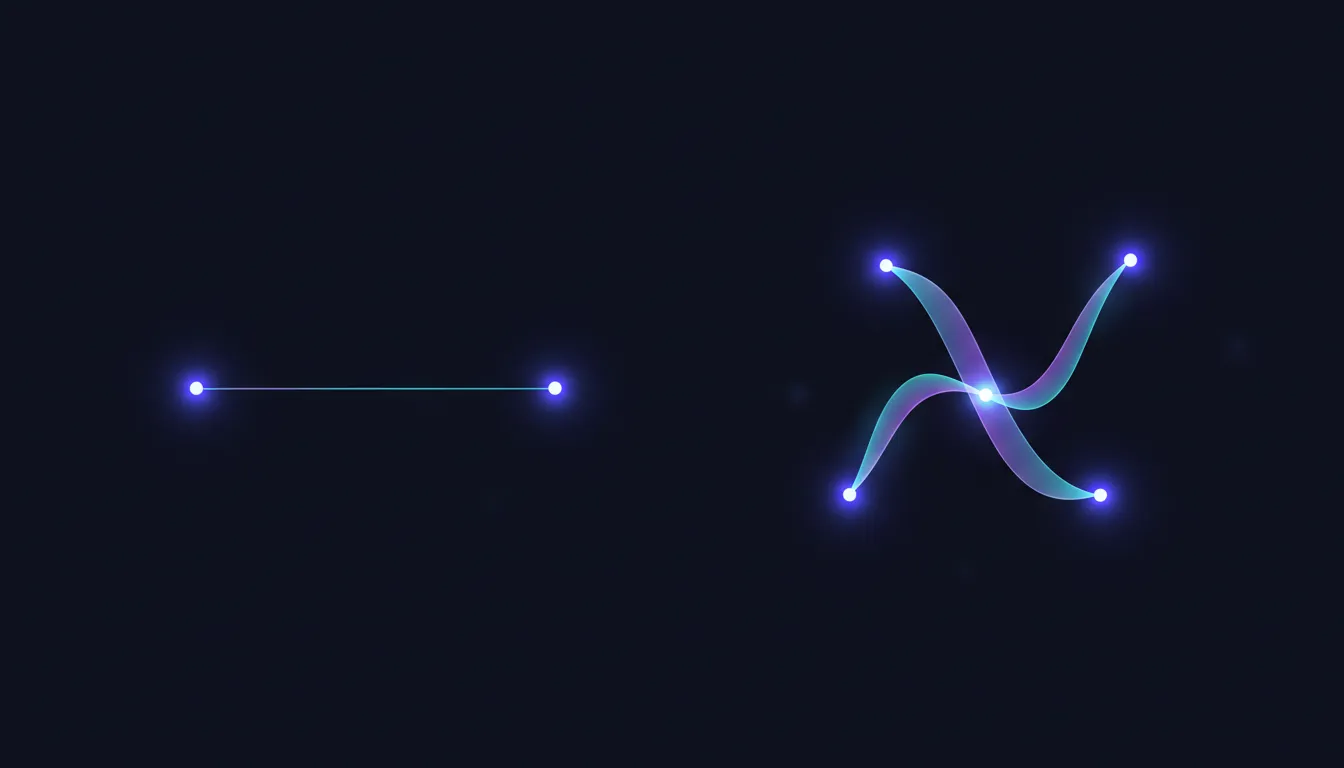
One rule, applied everywhere
The universe evolves by repeatedly applying a single rewriting rule. A rule says: wherever you find this little sub-pattern, replace it with that one. For example,
reads as: “find any edge ; keep it, and attach a brand-new node to .” The variables match existing nodes; is freshly created each time the rule fires.
At each step we apply the rule to every place it matches at once, producing the next state. Step through it below — press Play, or use Prev/Next to move one generation at a time, and drag nodes to untangle the structure:
{x, y} → {x, y}, {y, z} — each edge keeps itself and sprouts a new nodeDifferent rules, different universes
The whole project hinges on a striking idea: extremely simple rules can generate endlessly rich structure. Swap the right-hand side and the emergent “shape” of space changes completely. Here each edge instead closes up into a triangle, , which grows much faster and curls into a denser web:
{x, y} → {x, y}, {y, z}, {z, x} — each edge becomes a triangle with a new nodeWhy this matters
Apply a rule like this billions of times and the hypergraph can start to look like a smooth space with a definite dimension. The conjecture at the heart of the Wolfram model is that the familiar features of physics — the dimensionality of space, curvature and gravity, even the speed of light — are emergent large-scale regularities of this rewriting process, not assumptions baked in from the start.
A few threads to pull on from here (future notes):
- Causal graphs — which updates depend on which, and how that gives rise to a notion of time and to relativity.
- Multiway systems — applying every possible match in every order at once, and the link to quantum mechanics.
- The Ruliad — the entangled limit of all possible rules applied in all possible ways.
Note: the diagrams above use a deliberately simple engine — it matches single-edge patterns and rewrites every match each generation. Rules with larger left-hand sides need genuine subgraph matching, which is a natural next step for this component.