The Principle of Computational Equivalence
A single audacious bet — that almost anything not obviously simple is, deep down, as computationally sophisticated as anything else, our universe included.
Everything in this project rests on one striking idea, much older than the hypergraphs themselves. It goes back to Wolfram’s A New Kind of Science (2002): that extremely simple rules can produce arbitrarily rich behaviour — behaviour as complex as anything we find in nature. The Physics Project is, in a real sense, that single idea turned loose on physics itself. [setup]
In Computational Irreducibility we saw the flip side: when a system is genuinely complex, there’s no shortcut — you have to run it. The Principle of Computational Equivalence (PCE) is the bolder claim underneath. Roughly:
Almost all processes that are not obviously simple are equivalent in computational sophistication — each capable, in principle, of universal computation.
In other words, once a system stops being trivially simple, it tends to jump straight to the maximum level of computational power there is. There’s a vast, lonely gap between “obviously simple” and “as powerful as anything,” and PCE says almost nothing lives in between. [conjecture]
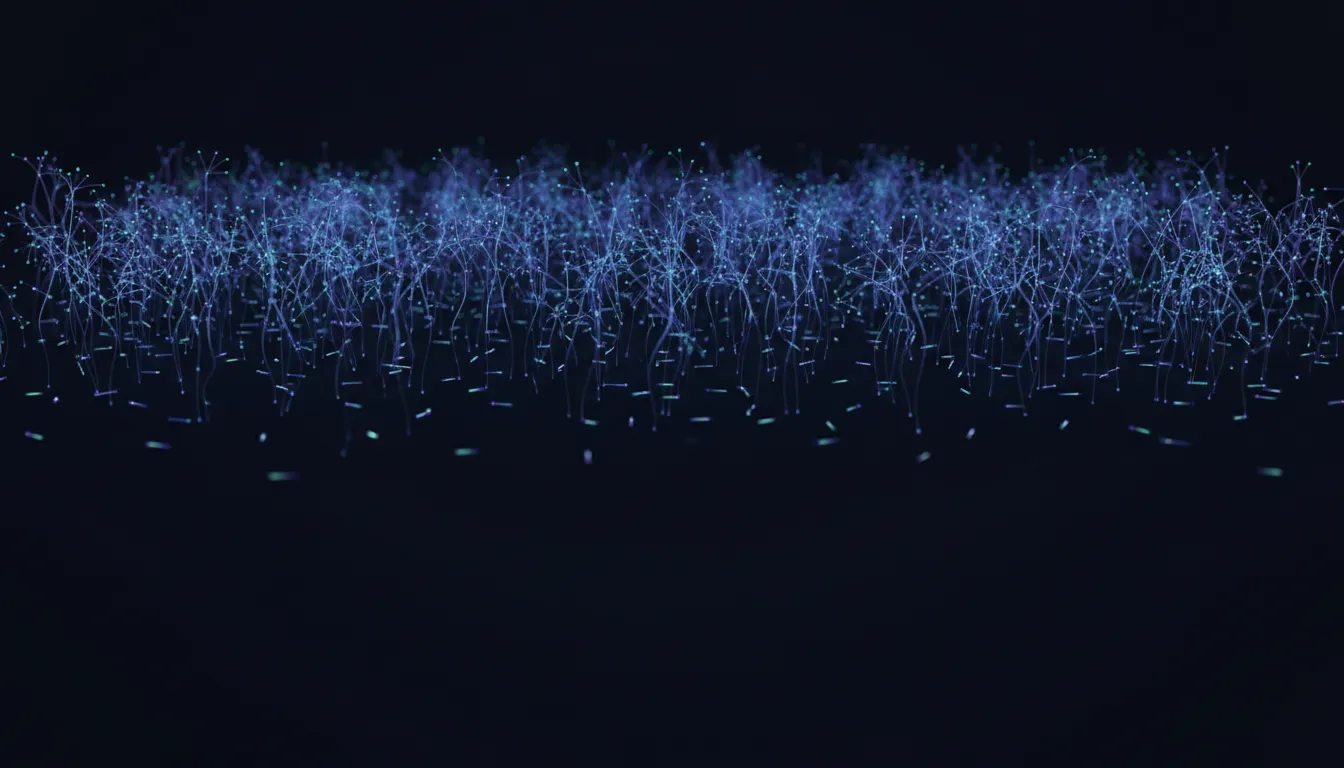
A dead-simple rule, already rich
Watch what one of the tiniest possible rewriting rules does — just “attach a new node to an edge,” applied everywhere at once. Nothing about the rule looks clever, yet the structure it grows is already intricate:
{x, y} → {x, y}, {y, z} — each edge keeps itself and sprouts a new nodeTry this: let it play, then ask yourself where in this rule you could have predicted the shape it ends up with. You can’t read it off the rule — you have to watch it run. Now swap the rule (
grow,subdivide,triangle) and notice how a minuscule change to the right-hand side gives a completely different world.
Two consequences that matter for physics
If PCE holds, two things follow that the whole project leans on.
First: a simple rule could, in principle, be enough to generate our universe. If even the humblest rules already reach the ceiling of computational power, then there is no reason the rule behind physics has to be complicated. The richness of the world is no evidence against a simple underlying rule — it’s exactly what PCE leads you to expect. Wolfram does not claim to have found that rule; PCE is what makes the search seem worth attempting at all. [conjecture]
Second: computational irreducibility becomes the norm, not the exception. If almost every interesting process is as sophisticated as a universal computer, then almost every interesting process is irreducible — you genuinely cannot outrun it with a formula. The neat, solvable corners of physics become the special cases: in the project’s later language, the established theories are framed as thin “slices of computational reducibility” sitting inside an ocean of generic irreducibility. [conjecture]
What's a claim, and what's a hope
PCE is a principle — a sweeping empirical conjecture Wolfram drew from surveying simple programs — not a theorem. It is not proven that a generic hypergraph rule is computationally universal, and certainly not that any particular rule generates our physics. [conjecture]
What we can state with confidence is narrower and well grounded:
- The lineage is real: the Physics Project is a direct continuation of A New Kind of Science’s thesis that very simple rules can yield arbitrarily complex behaviour, and the book reprints the NKS fundamental-physics chapter to make that explicit. Grounded here. [setup]
- Computational irreducibility — that some outcomes are obtainable “only by running the system step by step” — is a stated, load-bearing idea of the project from the start. 2020 announcement. [setup]
And the honest counterweight: critics argue this very flexibility cuts both ways. Scott Aaronson calls the framework so accommodating it can fit almost any result after the fact — an “infinitely flexible philosophy” — which is precisely the worry when a simple rule can do anything. Keep this in view.
So PCE is the engine of optimism behind the whole enterprise: it’s why one might hope a featureless hypergraph and one little rule could be enough. The next question is what that hope buys you concretely — and the first prize is the thing we take most for granted. On to Space from a Hypergraph, where a smooth, dimensioned space starts to condense out of the raw structure you just watched grow.
Sources for this page: A New Kind of Science / the book · 2020 announcement · 2021 one-year update · Scientific American critique