Curvature & Gravity
Curvature shows up as a tiny discrepancy in how fast a ball fills out as it grows — and from that discrepancy, gravity is argued to follow.
In Space from a Hypergraph we saw how a hypergraph can start to look like smooth space with a definite dimension — measured by counting how many nodes sit within distance and watching that count grow like . But real space isn’t just flat and -dimensional. It bends. So where, in a structureless web of relations, could curvature possibly hide?
The answer is wonderfully concrete: it hides in a small correction to that very counting. On a perfectly flat space a ball of radius contains a volume that grows exactly like . On a curved space it grows a little faster or a little slower — and the size of that “little” is exactly what a geometer means by curvature.
Curvature you can count
Picture drawing a circle of radius on a sphere versus on a flat sheet. On the sphere the disc you enclose is smaller than the flat would predict — the surface curves away under you. Shrink onto a saddle instead and you enclose more. The gap between the actual ball size and the naive is the fingerprint of curvature, and it first shows up at order .
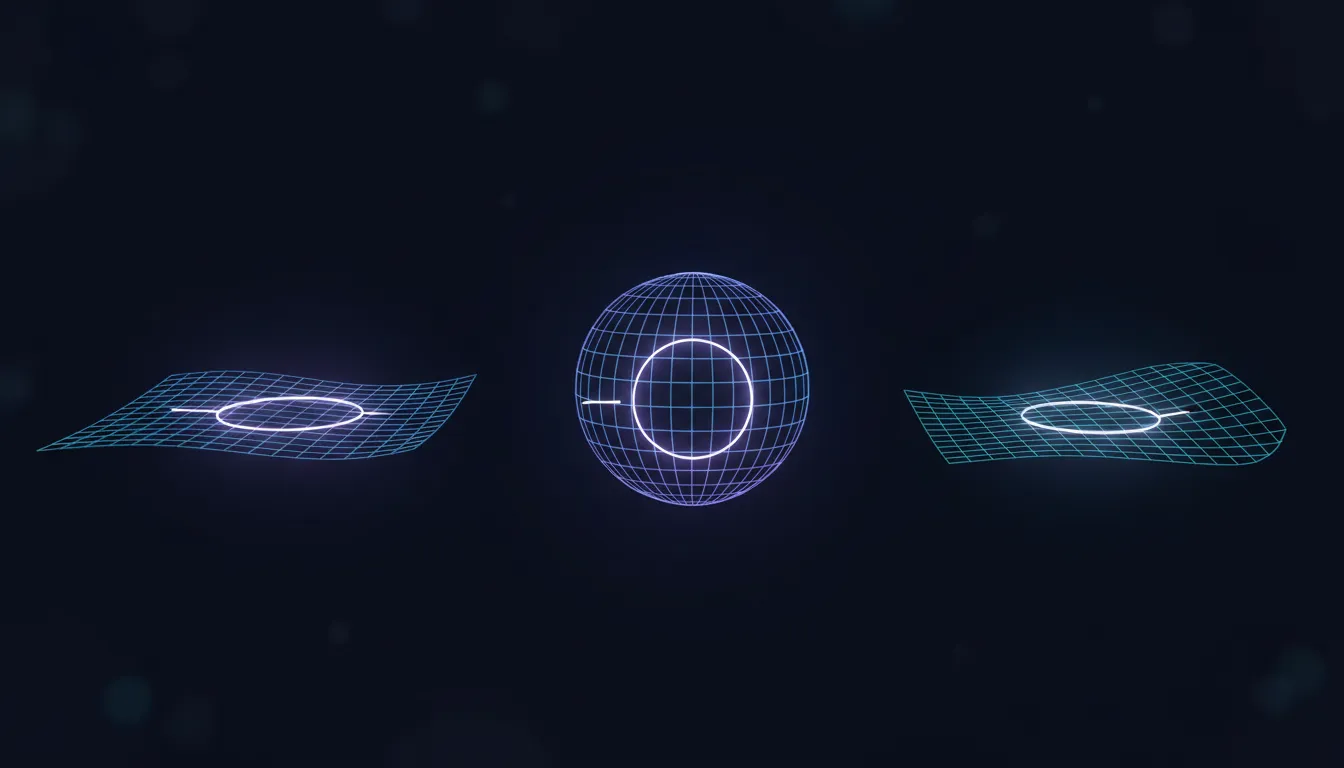
The two diagrams below run two different rules. They aren’t a literal measurement of curvature, but they make the underlying intuition visible — the same idea that lets the model define curvature by counting. The first rule lets each edge sprout a single new node, growing into a sparse, stringy structure:
{x, y} → {x, y}, {y, z} — each edge keeps itself and sprouts a new nodeThe second closes every edge into a triangle, so neighbourhoods fill in far faster and the structure curls into a denser web:
{x, y} → {x, y}, {y, z}, {z, x} — each edge becomes a triangle with a new nodeTry this: play both to the end and watch how quickly each one “fills up” around any given node. The stringy
growrule adds neighbours slowly; thetrianglerule packs them in. That difference in how fast a neighbourhood grows with distance is, in miniature, the difference between flatter and more strongly curved effective space. [setup]
From a counting correction to the Ricci scalar
Here is the bridge to physics. In ordinary differential geometry, the leading correction to ball volume is governed by a single number at each point — the Ricci scalar , the same curvature quantity that appears in Einstein’s equations. The Wolfram model takes the discrete version of that statement as its definition of curvature: measure how the node count inside radius deviates from , read off the order- term, and call the result the model’s Ricci scalar. [derived-in-model] (2020 announcement)
That’s a genuinely appealing move: dimension and curvature both fall out of the same operation — counting nodes within a distance — with no geometry assumed in advance.
The precise version (and exactly what is and isn't claimed)
For a -dimensional manifold, the volume of a small geodesic ball of radius expands as
where is a dimension-dependent constant and is the Ricci scalar at the centre. The Wolfram model estimates the same thing combinatorially — count the hypergraph nodes within graph distance — and identifies the order- shortfall with curvature. [derived-in-model]
From there Wolfram argues that, “in various limits, and subject to various assumptions,” the large-scale behaviour of these hypergraphs reproduces Einstein’s equations. [derived-in-model, partial] Two honest qualifications, both stressed in the source itself:
- The concrete claim is for the vacuum equations — empty space, no matter term. The full equations with matter are described as promised, not shown. [conjecture]
- A fully rigorous derivation is explicitly acknowledged as unfinished.
So the responsible one-line summary is: the model is claimed to recover the vacuum Einstein equations in certain limits, with the rigour openly incomplete — not that “Wolfram derived Einstein’s equations.” Grounded in Wolfram’s 2020 announcement; the formal, peer-reviewed treatment of the relativistic and gravitational properties is Gorard’s relativity paper, which is the source to trust over the blog essays.
Why this would be gravity
In general relativity, gravity is curvature — mass and energy tell spacetime how to bend, and that bending is what we feel as the gravitational field. So if a feature of the hypergraph (more activity, more “energy flux” through a region) makes the local node-counting deviate more strongly from flat , that region is more curved — and in the continuum limit that curvature would act exactly as gravity does. [conjecture] The proposed link between energy and that flux is developed alongside the causal graph picture, where it ties back to relativity.
A note of caution
It’s worth holding two things at once. The counting-based definition of curvature is clean and the connection to the Ricci scalar is real differential geometry. But the leap to “our models reproduce Einstein’s equations” is exactly the kind of limit-and-assumption-laden claim that skeptics have flagged. Reviewing the project in Scientific American, Scott Aaronson argued the framework is flexible enough to accommodate almost any result after the fact, and Daniel Harlow called the claimed successes “at best, qualitative.” [setup] (Scientific American critique) That’s why this page says claimed in certain limits and points you to Gorard’s formal paper rather than asserting a finished derivation.
Next we’ll see where the time half of spacetime comes from, and how slicing the causal structure into “moments” gives rise to reference frames, in Time, Foliations & Reference Frames.
Sources for this page: 2020 announcement · Gorard — relativity & gravity · Scientific American critique