Entanglement & Branchial Distance
If two quantum states are "close" in the branching tree of histories, the model proposes they are entangled — so a map of who-shares-an-ancestor becomes a map of entanglement itself.
This is the most speculative chapter in the most speculative part of the project, so read it with a light hand. In Quantum Mechanics from Branching we took the multiway system — the branching tree of every history the rule could follow — and proposed that its branches are the model’s version of quantum superposition. The obvious next question is the one quantum mechanics is famous for: what about entanglement, the spooky togetherness of states that seem to share a fate no matter how far apart they sit?
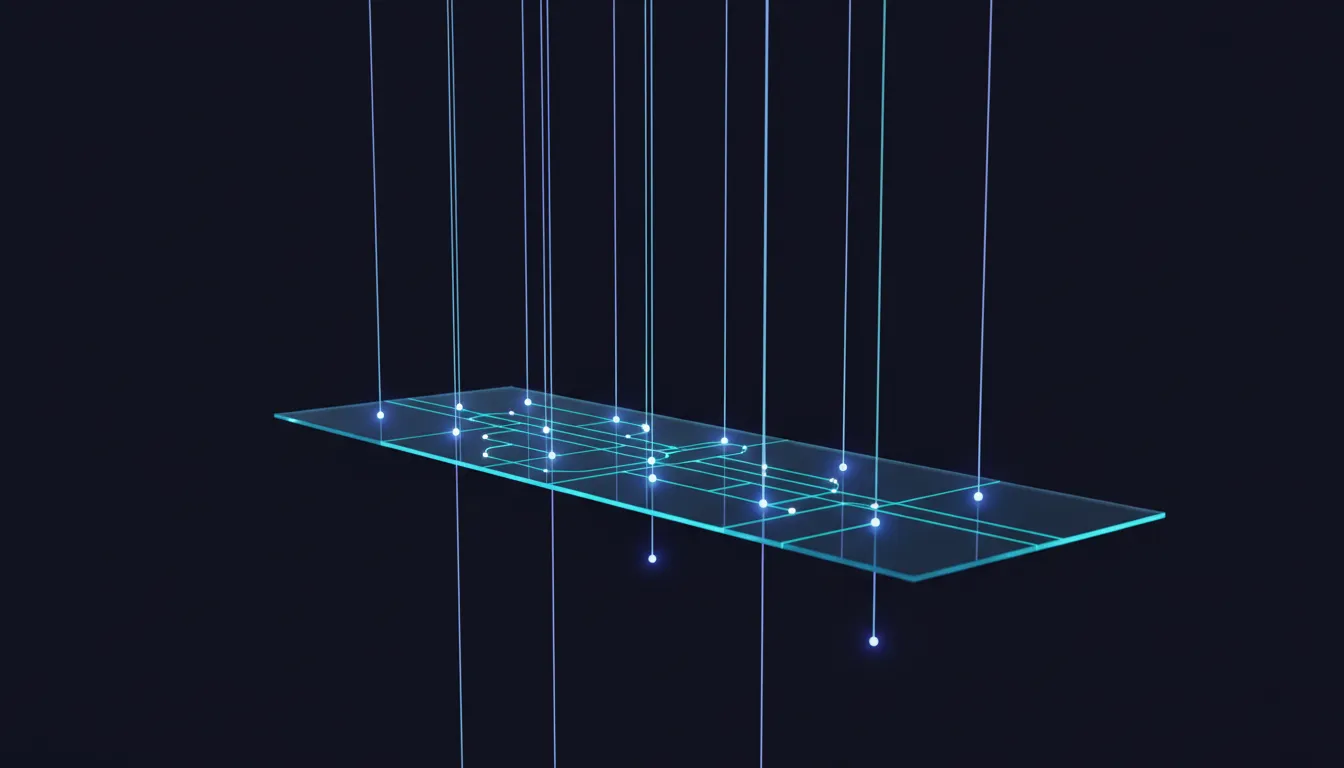
The model’s answer is disarmingly geometric. Take all the branches of the multiway system and ask, for any two states, how closely related are they — do they share a recent common ancestor, or did their histories part ways long ago? Arrange the states by that kinship and you get a new space, branchial space. The proposal is that nearness in branchial space is entanglement: states that branched off together recently are strongly entangled; states whose common ancestor lies far back are barely entangled at all. The branchial graph, in Wolfram’s phrase, becomes a map of the entanglements between states. [conjecture]
Crucially, this is a proposal, not established physics, and not something anyone has confirmed in a laboratory. Nobody has “explained entanglement.” What’s on the table is a claimed correspondence inside a particular model — interesting, suggestive, and very much unfinished. Keep that framing as we go.
A map made of shared ancestry
Start where we always do: the little string rule BA → AB, branching from BABA. Each
node is a possible state of the universe; each split is the rule firing in more than one
place at once.
BA → AB — wherever you see BA, you may replace it with AB. Green-outlined states are final (no move left).Try this: play it through and watch the system split into two states at the first step, then watch branches merge back later on. Now think about distance in a different direction. Don’t follow the arrows down through time — instead, for two states sitting “side by side” on the same level, ask how far back you’d have to climb to reach a state they both descend from. States that only just split share a very recent ancestor; they are branchially close. That sideways, same-moment notion of closeness is exactly what branchial space is built from — and what the model proposes encodes entanglement. [conjecture]
The multiway graph you’re looking at runs “downward” in time. Branchial space is the crosswise structure: a snapshot of one moment, with states linked when they share a recent ancestor. The model reads entanglement off that crosswise map, not off the flow of time. [conjecture]
Here is that crosswise map drawn directly — the branchial graph. Each box is a state
alive at one step; a link means they share a recent common ancestor, so the model counts
them as entangled. (Rule A → AB from AAA, which branches more richly.)
Try this: step between the early and later slices. Early on, a tight cluster of mutually-linked states — all freshly branched, all “entangled”. Later, the web spreads and only states sharing recent history stay linked. Reading entanglement off this map, rather than off the flow of time, is the whole proposal. [conjecture]
Why “distance” and not just “linked or not”
Entanglement in real physics isn’t all-or-nothing — states can be a little entangled or a lot. That’s why the model reaches for a distance, not a yes/no link. Wolfram posits a branchial metric: a way to measure separation in branchial space, so that “how entangled” two states are becomes “how close” they sit on the branchial map. Recent common ancestor, small distance, strong correlation; distant common ancestor, large distance, weak correlation. [conjecture] (2021 update)
And once you have a notion of distance, you can ask how fast things move across it — which leads to the most evocative idea on this page.
An entanglement horizon
In Special Relativity we found a speed limit in physical space: causality caps how fast influence can spread through the causal graph, and that cap is the speed of light. Wolfram proposes a loosely parallel limit in branchial space — an entanglement horizon: a bound on how fast branchial correlation (entanglement) can spread from one part of the multiway system to another. [conjecture]
The analogy is deliberate but should be held gently. In ordinary spacetime, an event horizon (or the light cone) marks a frontier that influence cannot cross quickly enough; the entanglement horizon is meant to play a similar role one level up, in the space of quantum branches rather than the space of points. It is offered as an analogy and a proposal, not a measured quantity or a theorem — the popular essays introduce it in a single phrase, and it is among the least developed ideas in the whole framework. [conjecture] (2020 announcement)
Try this (thought experiment): imagine “lighting up” one state in the branchial map and asking how quickly its neighbours can become correlated with it. The entanglement horizon is the claim that this spreading has a maximum rate — a branchial-space echo of “nothing outruns light.” Whether such a bound really holds, and what sets its value, is open. [conjecture]
The precise version — and where the real rigor lives
The careful treatment of quantum mechanics in the Wolfram model is Jonathan Gorard’s Complex Systems paper, not the popular essays — and it is far more guarded and technical than the blog framing. Prefer it for any quantum claim. (Gorard — quantum)
A few things can be stated responsibly:
-
Branchial space is a limit of branchial graphs. Nodes are states sharing a common ancestor in the multiway system; the branchial graph for a slice records that kinship, and (as with emergent physical space) a continuum branchial space is taken as a limit. Wolfram describes this space as said to “correspond to a space of quantum states.” [setup → claimed correspondence] (2021 update)
-
Entanglement ↔ branchial proximity is the core proposal of this page. The branchial graph is said to encode entanglement, with branchial proximity standing in for it. Treat this as a claimed correspondence inside the model, not a derivation of textbook entanglement. [conjecture] (2020 announcement)
-
Where formal content actually appears. Gorard’s paper develops quantum behaviour from multiway / branchial structure and connects it to the Feynman path integral and to Bell / CHSH inequalities — the genuinely technical core. The 2021 update separately frames the quantum correspondence as matching categorical quantum mechanics, described as a “proof by compilation.” These are model-internal results, not independent experimental confirmations. [derived-in-model] (Gorard — quantum · 2021 update)
-
The branchial metric and the entanglement horizon are conjectural. A metric on branchial space and a speed-limit-like entanglement horizon are posited by analogy with physical distance and the light cone. They are aspirations and analogies, stated briefly, not worked-out results. [conjecture] (2020 announcement · 2021 update)
So the honest one-liner is: the model proposes that entanglement is encoded by closeness in branchial space, with formal support (path integral, Bell/CHSH) developed in Gorard’s paper — not that Wolfram “explained entanglement.”
A note of caution
It is worth keeping both the appeal and the limits in view. The picture is genuinely elegant: superposition as branching, entanglement as branchial nearness, a speed-limit for correlation mirroring the speed of light — a single substrate apparently giving rise to several quantum features at once. But elegance is not evidence. This region of the project is openly the least developed and most speculative, the popular essays introduce the entanglement horizon in barely a phrase, and the 2021 update is self-published rather than peer-reviewed. Reviewing the project in Scientific American, Scott Aaronson argued the framework is flexible enough to accommodate almost any result after the fact, and Daniel Harlow called the claimed successes “at best, qualitative.” The project also bypassed normal peer review while drawing heavy media attention. [setup] (Scientific American critique)
That is why every quantum claim here is tagged [conjecture] (or [derived-in-model] for the formal correspondences in Gorard’s paper), and why we lean on that paper rather than the blog essays. Branchial distance as a map of entanglement is a beautiful idea to explore — not a finished piece of physics.
If entanglement is a map of shared branching, the natural next question is what happens when an observer reaches in and reads off a single outcome — how branching histories get knitted into the one classical world we actually experience. That’s the subject of the next chapter, Measurement & the Observer (coming soon).
Previous: Quantum Mechanics from Branching · Next: Measurement & the Observer (coming soon)
Sources for this page: Gorard — quantum · 2021 update · 2020 announcement · Scientific American critique