Branchial Space
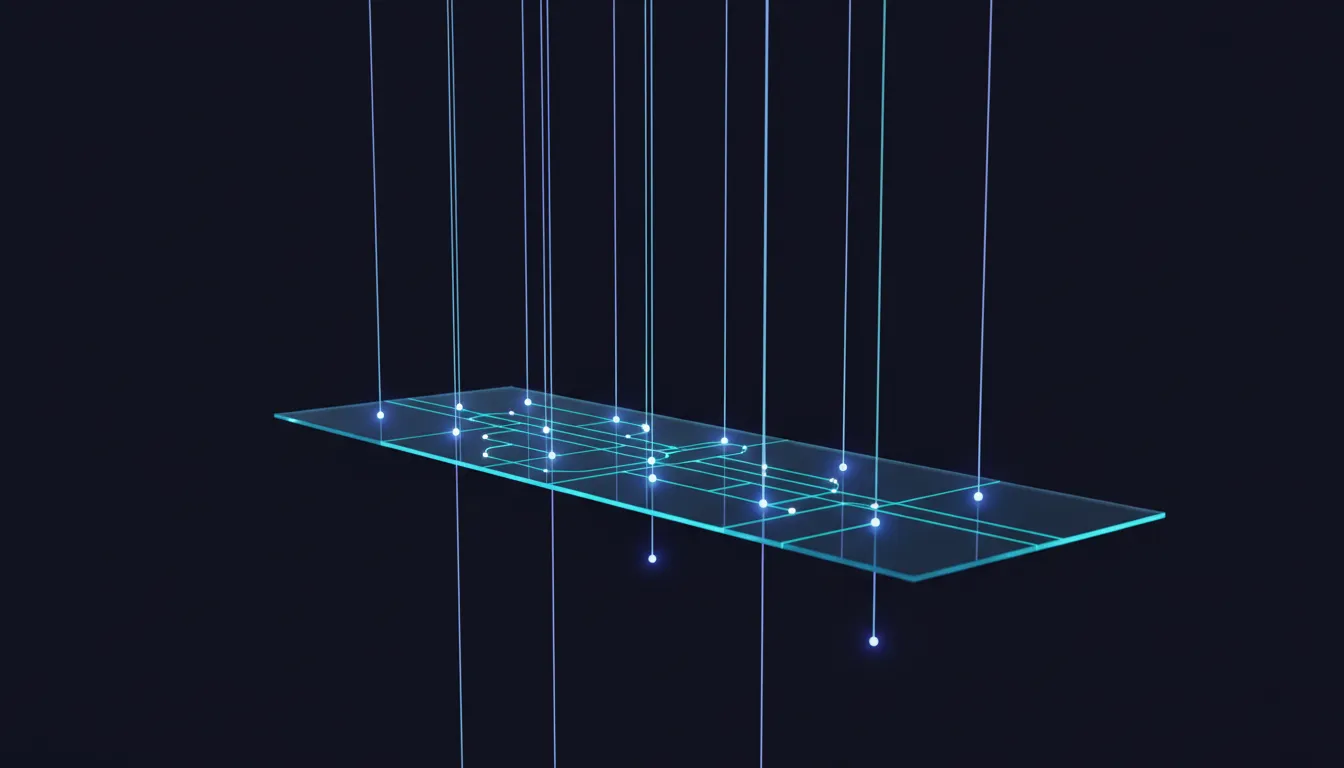
Take all the histories that coexist at one instant of the multiway system, link the ones that just split apart, and zoom out — you get a second emergent space, proposed as the arena where quantum mechanics lives.
In Multiway Systems we let the rule fire every way it could and watched a whole tree of histories branch and re-merge. That tree has a feature we mostly ignored: at any given step, several different states are alive at once — genuine parallel versions of the universe. This page is about the space you get when you ask how those coexisting versions are arranged relative to one another.
The idea is a clean parallel to Space from a Hypergraph. There, ordinary physical space was the large-scale shape of the spatial hypergraph — zoom out on the tangle of relations and a smooth geometry appears. Here we do the same trick on a different graph, built not from relations inside one state but from the kinship between the many states at the same multiway step. Its large-scale limit is branchial space — and Wolfram proposes it is the arena for quantum mechanics. [setup]
Slice the multiway graph, then connect siblings
Here is the same branching/merging multiway system from before — rule BA → AB,
starting from BABA. Don’t follow it top-to-bottom this time. Instead, hold one
level of the graph fixed in your mind: all the states that exist at the same
step.
BA → AB — wherever you see BA, you may replace it with AB. Green-outlined states are final (no move left).Try this: play to the first split, where the single start state opens into two states living side by side. Those two are branchlike separated — siblings that just diverged from a shared parent one step back. In the branchial graph you’d draw a link between them. Do that for every level and you have built the branchial graph: states that share a recent common ancestor get connected. [setup]
So the recipe is short. Take the states present at one step of the multiway evolution. Connect two of them when they share a recent common ancestor — a branchlike connection, the multiway cousin of “being close together.” The graph you get on each slice is the branchial graph, and its large-scale limit is branchial space. [setup] (2021 update, technical paper)
The branchial graph, drawn directly
Below is that recipe carried out for you — using the rule A → AB from AAA, which fans
out more richly than the earlier example. Each box is a whole state of the universe alive
at one step; a link joins two states that just branched from a common ancestor.
Try this: at the first step the states form a tight triangle — they all just split from the same parent, so they’re all branchially close (all mutually “entangled”). Press Later and it grows into a richer web of six, where the clusters begin to overlap: each state stays linked only to the cousins it shares recent history with. That shifting web of who-shares-ancestry-with-whom is, in miniature, the geometry Wolfram calls branchial space. [setup]
Notice what kind of “closeness” this is. Two states sit near each other in branchial space not because they are near in physical space, but because they share history — they only just branched apart. Branchial distance measures common ancestry, a completely different notion of nearness from the spatial one. [setup]
A second space, for a different job
This is the move worth pausing on. The Wolfram model now has two emergent spaces, pulled out of the same underlying rewriting by two different limits:
- Physical space — the large-scale limit of the spatial hypergraph: where things are. (See Space from a Hypergraph.) [setup]
- Branchial space — the large-scale limit of the branchial graph: how the coexisting quantum branches are arranged. [setup]
And here is the claimed correspondence, which is the whole reason branchial space is interesting. Wolfram proposes that branchial space “corresponds to a space of quantum states,” with the branchial graph encoding the entanglements between them — states that are close in branchial space being the ones that are entangled, and an “entanglement horizon” bounding how far that reaches. [conjecture] (2021 update, 2020 announcement)
Said plainly: where physical space is the arena for ordinary mechanics, branchial space is offered as the arena for quantum mechanics — a place whose points are quantum states and whose geometry is entanglement. That is a striking proposal, and it is exactly that: a proposal, not established or experimentally confirmed physics. It is among the most speculative parts of the entire project, and the popular essays are candid that quantum mechanics is the least-developed corner of the framework. [conjecture] (2020 announcement)
The precise version: branchlike separation and the bridge to Hilbert space
In the formal write-up, the branchial graph connects states (or events) that are branchlike separated — on different branches of the multiway system at the same step — as opposed to spacelike separated (different places at the same time) or timelike separated (cause and effect). It is built as a slice through the multiway structure, and it is presented as the substrate for the project’s quantum / Hilbert-space structure. [setup] Crucially, causal invariance guarantees that diverging branches eventually re-merge, which is what keeps the branching from fracturing into incompatible worlds — see Causal Invariance. [setup] (Technical paper)
The leap from “graph of branchlike-separated states” to “space of quantum states with entanglement” is the claimed correspondence, and it is where the work has to be done carefully. The rigorous, peer-reviewed treatment is Jonathan Gorard’s quantum paper — Some Quantum Mechanical Properties of the Wolfram Model — which develops quantum-mechanical behaviour from multiway and branchial structure, including connections to the path integral and to Bell / CHSH inequalities. Wolfram separately frames the correspondence as one to categorical quantum mechanics, described as a “proof by compilation.” [derived-in-model] When we work through the quantum claims in detail, Gorard’s quantum paper is the source to trust over the blog essays. [derived-in-model] (2021 update, Gorard — quantum)
A note of caution
Keep the same balance as the rest of these notes — and lean on it harder here, because this is the most speculative ground in the project. “Corresponds to a space of quantum states” is a claimed correspondence, not a demonstration that nature’s Hilbert space is a branchial graph, and not an independent experimental result. The relevant sources are self-published essays plus one formal paper; nobody has confirmed branchial space against an experiment, and the framework has produced no novel confirmed quantum prediction. [setup]
The skeptics’ worry bites especially here. Reviewing the project in Scientific American, Scott Aaronson argued the framework is flexible enough to accommodate almost any result after the fact, and Daniel Harlow called the claimed successes “at best, qualitative”; the work also bypassed normal peer review while drawing heavy media attention. [setup] (Scientific American critique) None of that makes branchial space wrong — but it is exactly why this page says proposed and corresponds to, and never that Wolfram has explained or derived quantum mechanics.
With a candidate arena for quantum states in hand, the natural next question is how ordinary quantum behaviour — superposition, interference, measurement — is argued to play out across these branches. That’s Quantum Mechanics from Branching.
Sources for this page: 2021 update · Technical paper · 2020 announcement · Gorard — quantum · Scientific American critique